
Why Enrollment Accuracy Breaks Down at Intake
Automation makes enrollment processing faster, not more accurate, and payer operations teams feel that gap every renewal season. A record can move through a system quickly and still carry an error that nobody catches until it resurfaces in claims or eligibility, weeks after the enrollment window closes.
The problem often starts much earlier than teams expect. Enrollment data still arrives through disconnected channels, forms, email, portals, EDI feeds, each with its own format and failure points, and intake teams must sort and validate this volume largely by hand.
Validation often happens after a record has already been entered into the enrollment system, so by the time an error is visible, it is no longer an intake problem. It is a downstream one.
Enrollment operations in 2026 do not need faster processing. They need intelligent intake of member enrollment workflows that catch inconsistencies at the first point of contact rather than passing them along.
The Accuracy Problem in Modern Enrollment Operations
Enrollment errors rarely stay in one place. A miscoded dependent relationship or a mismatched effective date flows into eligibility checks, then claims adjudication, then a member experience that looks like a billing problem, even though the failure occurred weeks earlier.
Inconsistent formats across channels, manual entry errors, and the ongoing task of reconciling what a source submits against what loads; all compound in the same way: fixing an error downstream always costs more than catching it at intake.
Why Traditional Enrollment Intake Falls Short
Fragmented Channels Create Blind Spots
Most enrollment operations handle EDI, email, portal, and paper submissions as separate workstreams, each running its own payer intake workflow with its own queue and its own definition of a complete record.
There is rarely a unified view of volume across channels, so backlogs go unseen until they form.
Manual Triage Cannot Scale with Volume
Manual triage during the Annual Enrollment Period or Medicaid redetermination cycles struggles to keep pace as volumes exceed what staff can sort cleanly under time pressure. As a result, prioritization becomes reactive rather than risk-based.
Validation Happens Too Late in the Process
Traditional intake also tends to validate a record’s completeness without validating its accuracy: a record can pass a formatting check and still carry an error only a downstream system catches, turning what should be prevention into rework.
What Intelligent Intake Really Means
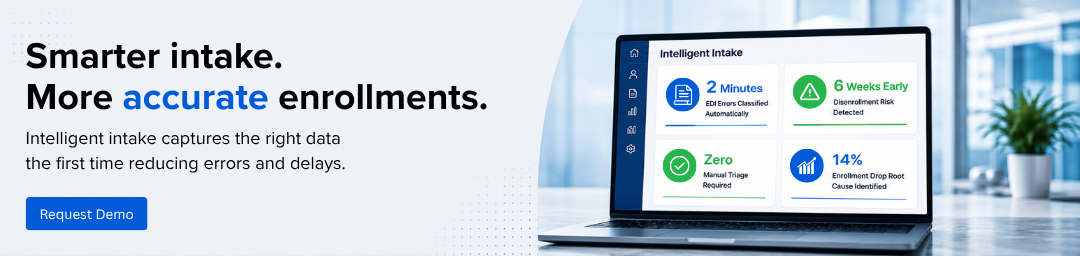
Intelligent intake is not intake with a faster interface. It is a shift toward AI-driven classification and validation that begins the moment data enters the system rather than after it has already moved downstream. Intelligent intake helps ensure enrollment data is accurate from the first touch instead of requiring correction later.
Every channel feeds into a single, unified queue rather than separate silos; the system automatically validates and classifies records as they arrive; and prioritization is based on risk rather than on manual judgment under time pressure. Intake stops functioning as a front door and becomes the first checkpoint in a connected system.
How Intelligent Intake Prevents Enrollment Errors Before They Occur
Unified Multi-Channel Intake
Bringing EDI, email, portal, and SFTP submissions into one queue means teams handle every transaction to the same standard, and operations teams gain a single view of volume and status.
Real-Time Validation, Classification, and Autofill
The system validates and classifies records immediately as they arrive, and it can auto-populate known member data from existing records instead of staff re-entering it by hand.
Clean transactions move forward automatically; records that fail validation route for review before they load. This is what closes the gap left open by traditional intake: catching an error before it becomes a record, rather than correcting a record after it becomes an error.
Closing the Loop Between Intake, Processing, and Data Integrity
Exception Handling That Keeps Pace with Volume
Records that fail validation move into structured exception queues that assign cases by type, priority, and SLA exposure, so the highest-risk items surface first.
Reconciliation That Catches What Intake Missed
Automated reconciliation compares the records a plan receives against the records it processes, flagging gaps and missing enrollments in real time rather than at the end of a cycle.
A Single Source of Truth for Every Member
A consolidated member profile pulls clean data from every intake source into a single record. Intelligent matching flags duplicate records across channels, while member updates sync to downstream systems in real time, creating one accurate record instead of several partial ones that staff would otherwise reconcile manually.
Operational Visibility for Enrollment Leadership
Role-specific dashboards for processors, supervisors, and managers provide each level with the data relevant to its decisions.
Error trend analysis matters as much as volume reporting: knowing errors are occurring is not the same as knowing where they originate. Visibility into centers on root cause enables leadership to shift from reacting to preventing recurring issues.
Business Impact for Health Plans and Payer Operations
Fewer errors entering the system mean fewer manual touches and less rework downstream.
This is where healthcare enrollment automation delivers measurable value. Exceptions that would otherwise sit in a general queue for days resolve faster because the system already ranks them by priority. This gives operations teams more capacity to absorb enrollment surges without adding headcount every cycle.
Because every channel feeds the same validation standard, member data stays consistent regardless of where it enters the system.
From Manual Intake to Accuracy by Design
Automation alone is not enough to solve enrollment accuracy, because it only moves data faster. Intelligent intake moves accuracy to the first point of contact, so teams build it into the process instead of applying a correction downstream after the damage occurs.
Health plans that treat intake as a strategic layer, not an administrative front door, spend less time cleaning up after enrollment and more time trusting the data enrollment produces.
See how intelligent intake strengthens member enrollment accuracy from the first point of contact: EnrollmentIQ
Frequently Asked Questions
What does “intelligent intake” mean in member enrollment operations?
AI-driven classification, validation, and routing of enrollment data as it arrives, rather than staff manually sorting records and validating them only after they are already loaded.
How does automated validation at intake reduce enrollment errors?
It checks records against validation rules and known member data at the point of entry, catching inconsistencies before they load so the error never becomes a downstream claims issue.
Does intelligent intake eliminate the need for manual review?
No. Clean records move forward automatically, while records that fail validation route to staff for structured exception handling, so teams concentrate manual effort where the work actually needs it.
How does intake data quality affect downstream claims and eligibility accuracy?
An enrollment error that goes uncaught at intake carries forward into every system that depends on that record, including eligibility verification and claims adjudication, where it resurfaces as a denial or a member-facing issue rather than an intake correction.
Can intelligent intake handle enrollment surges like AEP or redeterminations?
Yes. Because a unified queue prioritizes intake by risk, teams absorb higher volume without a proportional increase in manual triage effort.