
Claims productivity depends on more than how fast an individual examiner works.
It depends on whether the right claim reaches an examiner who is both qualified to handle it and has capacity available at that moment. That assignment decision is made before any work begins and can influence how much of the team’s available capacity is converted into completed work, regardless of individual effort.
Distribution, capacity, and productivity are often used interchangeably in claims operations, but they are not the same.
Capacity is how much work an examiner can actually take on at a given moment. Turnaround time is the time from intake to resolution. Productivity is the amount of completed work relative to the capacity available to the team, and backlog is what accumulates once work begins to exceed the team’s ability to complete it within the required timeframes.
Work distribution sits beneath these measures: it determines which claims go to which examiner, which in turn influences how much of that capacity actually turns into finished work.
Why Manual and Static Assignment Limit Productivity
Many claims operations still use some combination of manual triage, a fixed rotation, first-come-first-served ordering, or a static list that may not account for what a given examiner is actually equipped to handle right now.
The mechanism is simple enough: a claim lands in the queue and moves to the next available examiner in sequence, regardless of complexity or that examiner’s current workload.
This is not a case of operations leaders missing something obvious. Most know examiners vary in expertise, and that workload shifts hour to hour. The real issue is that these assignment models were built for a simpler environment, less claim variety, and more predictable volume, and nobody has gone back to redesign them as complexity has increased.
The result can be uneven utilization, and it happens constantly. At any given moment, some examiners may be carrying claims outside their strength while others have available capacity, because nothing in the assignment mechanism is built to catch that imbalance in real time. Turnaround time on similar claims starts to drift, and claims operations productivity varies by examiner in ways individual skill alone does not explain.
For leadership, that creates a diagnostic trap. A productivity gap may be treated as a staffing or training problem when the actual cause lies in how work is routed. Adding headcount or more training may not fix a gap created by assignment logic that never matched claim complexity to who could actually handle it.
What Actually Drives Productivity Loss in Claims Queues
Three mechanisms explain most of the gap between a queue that runs predictably and one that generates avoidable delays or backlog.
Assignment That Does Not Account for Examiner Expertise
Claim complexity is not uniform. A coordination-of-benefits claim demands more judgment and more time than a routine outpatient claim, but static assignment logic rarely distinguishes between them; it sends both to whoever is next, regardless of experience.
Complex claims can end up with examiners who have never really worked that claim type and take longer than they should, while examiners who actually know the work sit on claims well below their skill level.
This is worth watching for in the metrics, too: average handle time can look perfectly normal even when it hides a real mismatch, because a slow, complex claim and a fast, simple one can average out to something that looks fine on a dashboard.
Assignment Rules That Are Fixed at a Single Point in Time
Most rotations get set once, usually at the start of a shift, and then nothing updates them as the day actually unfolds.
An examiner clears a batch of simple claims by mid-morning and has real capacity to spare. Someone else is three hours into a complex claim with no relief in sight.
The assignment system has no way to see either fact, so that capacity just sits there unused, not because it does not exist, but because nothing in the process knows to redirect it. This matters specifically for capacity planning: headcount numbers can look adequate on paper, while the underlying distribution mechanism has no way to deliver that capacity where it is needed within the shift.
Limited Visibility into Where Work Is Accumulating
Most claims reporting is good at showing what has already been done. It is often less effective at showing where work is accumulating in real time.
A supervisor usually finds out about a developing backlog only once turnaround time has already taken the hit, which means the response is always reactive, never preventive.
This is a visibility gap, not necessarily a capacity gap; the information a supervisor would need to step in earlier often just isn’t in the reporting, regardless of whether the team actually had enough capacity to prevent the backlog in the first place.
A Diagnostic Pattern Worth Recognizing
A mismatch between claim complexity and examiner experience shows up repeatedly in claims operations that rely on static assignment, and it is worth treating as a diagnostic rather than just a story.
A claim requiring specialized handling, a coordination-of-benefits determination, for example, enters the queue during a standard rotation cycle. It goes to the next available examiner, someone who primarily handles routine claims and has limited recent experience with this claim type.
Processing takes longer than it would with a more experienced examiner, may require an escalation or two for clarification, and, in some cases, misses the turnaround time target before a supervisor even notices that reassignment is needed.
Here is the question worth asking internally: how often does this specific sequence occur, and is it tracked as its own category of turnaround-time miss, or does it just disappear into general performance averages? If a health plan cannot answer that with existing data, that itself is a visibility gap in how distribution-related delays get measured.
Route that same claim through an assignment mechanism that actually factors in complexity and expertise at intake, and it goes to someone with relevant experience and the capacity to take it on. That does not guarantee a faster outcome every time, but it does remove this specific failure mode, a claim type routinely mismatched to examiner background, as a recurring source of delay.
What Changes with Intelligent Work Distribution
Claims productivity improvement here means something specific: closing the gap between the capacity a team already has and the capacity it actually uses, not asking examiners to simply do more.
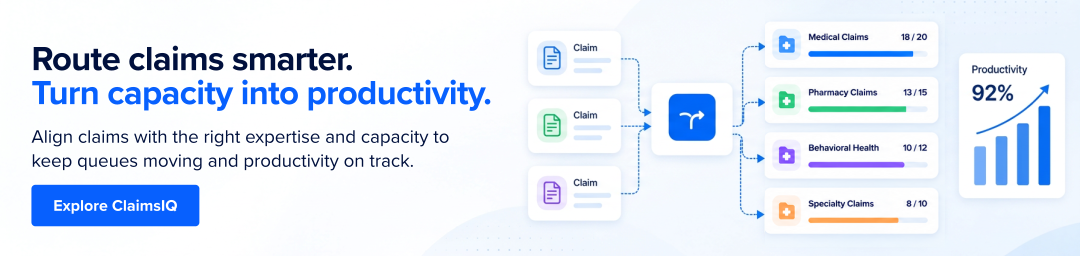
The mechanism is an assignment logic that weighs claim type, complexity, aging, turnaround-time exposure, priority, and examiner expertise at the time of routing, rather than defaulting to queue position.
The second piece is a continuous evaluation instead of a fixed one. Rather than locking in an assignment at shift start, workload distribution can be reassessed as the workload and capacity change throughout the day, helping close the capacity-detection gap described above.
Third is queue visibility, which shows accumulation as it forms, not after the turnaround time has already taken the hit. That can move leadership from reactive correction to earlier intervention, though it will not fix a genuine capacity shortfall, only a misallocated one.
Workflow automation in healthcare claims operations can address different stages of work, including routing and prioritization. The key distinction is whether a system only responds to a backlog that has already formed, or also helps identify and redirect work before imbalances become larger operational problems. Those are two different capabilities, and an operation weighing automation options should evaluate them separately rather than assume one comes bundled with the other.
Where This Approach Introduces Risk
Automated distribution is not a free upgrade. Treating it purely as an efficiency gain overlooks real trade-offs that leadership should weigh.
- Removing human override entirely can leave genuinely atypical claims assigned according to rules that do not fit their circumstances, cases where a supervisor’s judgment would likely produce a better outcome than the default logic.
- Frequent rebalancing can disrupt an examiner’s continuity on a claim they are already becoming familiar with, offsetting some of the efficiency gained through better initial matching.
- Rules configured once and never reviewed drift out of alignment with actual claim mix and examiner skill development over time, reproducing a version of the same staleness problem static rotations already have.
None of this argues against intelligent distribution. It argues for keeping a human in the loop and periodically revisiting the rules, rather than treating a one-time setup as permanent.
A Framework for Evaluating Work Distribution
The mechanisms above collapse into four questions operations leadership can ask about an existing claims operation, independent of any specific platform:
- Expertise alignment: Does assignment logic route claims according to examiner background and claim type, or mostly by queue position?
- Capacity responsiveness: Does workload distribution reflect current capacity throughout a shift, or only capacity as assessed at one starting point?
- Queue visibility: Is work accumulation visible to supervisors as it develops, or does it usually surface only after turnaround time has already been affected?
- Override capacity: Can a supervisor redirect an assignment that does not fit a given case, or is the assignment final once applied?
These four questions serve as a diagnostic to determine whether new technology is on the table. An operation that can answer all four with confidence is probably already getting most of the productivity its current staffing allows. One that cannot have a real starting point, distribution, or staffing is likely the more direct lever available. Intelligent work distribution claims teams evaluate this way tends to show which lever actually applies before anyone commits to a headcount decision.
Where Claims Distribution Practices Are Trending
Claims operations are increasingly exploring routing models that account for factors such as claim type, complexity, examiner expertise, and workload rather than relying solely on queue position.
A fixed rotation used to be the unquestioned default. Now it increasingly reads as a constraint on capacity utilization instead of a neutral baseline. Intelligent claims routing here means closing that specific gap, not automation in a general sense.
Distribution Is a Prerequisite for Productivity Gains, Not a Substitute for Staffing Decisions
More headcount adds capacity. It does nothing to address whether that capacity, old or new, is actually routed well. An operation with a distribution problem will likely see the same imbalance recur on a larger scale once new staff arrive, because the underlying assignment mechanism has never changed.
Looking at distribution first allows leadership to separate two different problems: a genuine capacity shortfall and capacity that already exists but is not being used well.
Platforms structured around expertise alignment, capacity responsiveness, and queue visibility can help address this specific gap. ClaimsIQ is one example of a platform that can be evaluated against these criteria.
Frequently Asked Questions
What is intelligent work distribution in claims processing?
Intelligent work distribution means assignment logic that weighs claim complexity, aging, priority, and examiner expertise at the point of routing, rather than defaulting to queue position or a fixed rotation.
How does work distribution affect claims productivity specifically, as distinct from staffing levels?
Work distribution determines how effectively existing capacity converts into completed work. Two operations with identical staffing levels can yield different productivity outcomes if one distributes work according to expertise and real-time capacity, while the other relies on static assignments that account for neither.
Does intelligent work distribution reduce the number of examiners a claims operation needs?
Not necessarily. Its job is to improve how well existing capacity is used, not to cut total capacity requirements. Whatever staffing implications exist depend on an operation’s current utilization rate, which intelligent distribution is actually meant to reveal more clearly in the first place.
What is the primary risk associated with fully automated claims routing?
Removing human override entirely can result in atypical or ambiguous claims getting assigned according to rules that do not account for case-specific circumstances a supervisor would otherwise recognize. Retaining override capability mitigates this risk without eliminating the efficiency gains from automated routing in typical cases.
What is a reliable indicator that a work distribution approach is functioning effectively?
Turnaround time consistency across examiners handling comparable claim types is one useful indicator. Significant variation in turnaround time for similar claims, without a clear underlying cause such as case complexity, often points to a distribution issue rather than an individual performance issue.